This course would be of particular interest to engineers in government agencies and the military concerned with construction practices and to engineers in the construction industry.
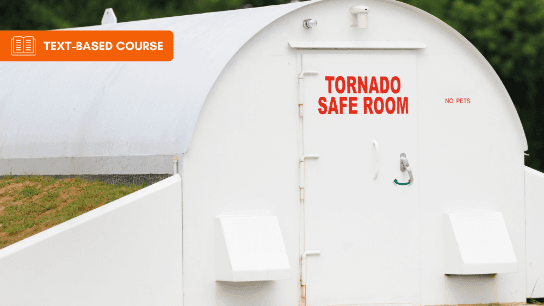
Every year, tornadoes, hurricanes, and other extreme windstorms injure and kill people, and cause millions of dollars worth of property damage in the United States. Even so, more and more people build homes in tornado- and hurricane-prone areas, possibly putting themselves in the path of such storms. This course is based on the FEMA publication, “ Taking Shelter From the Storm: Building a Safe Room For Your Home or Small Business” and covers the design and construction of storm-resistant safe rooms that provide near-absolute protection from tornado or hurricane winds and associated flying debris. The designs considered are applicable to homes, small businesses, and small community shelters. This course would be of particular interest to engineers in government agencies and the military concerned with construction practices and to engineers in the construction industry.
Topics: Procedures for assessing risk and determining if building a safe room is appropriate Alternative safe-room locations such as underneath, in the basement, or in an interior room of a new home or small business Effects of type of foundation on safe-room design Design guidance on how to add a safe room to an existing structure Selection of appropriate construction materials Cost estimating for safe-room construction Safe-room designs for homes or small businesses that meet or exceed the minimum shelter design requirements from the ICC-500 Storm Shelter Standard.
Intended Audience: for civil, construction, structural, and mechanical engineers. Publication Source: US Federal Emergency Management Authority
Civil Engneering faculty member for 27 years
Dr. Rossow is a graduate of the University of Michigan with B.S., M.S., and Ph.D. degrees. He is a licensed Professional Engineer in the State of Illinois. He taught civil engineering for over 35 years, including six years at Washington University in St. Louis and 29 years at Southern Illinois University Edwardsville, where he was the Chair of the Civil Engineering Department for ten years. His areas of expertise are in civil engineering and mechanics. He has consulted for various organizations, including government agencies and an international offshore drilling company. He has published numerous technical journal articles and technical reports for a variety of governmental agencies and private sector organizations. Mark P. Rossow, PE, PhD Licensed Professional Engineer in State of Illinois License No. 062.040560 Dr. Rossow is a graduate of the University of Michigan with B.S., M.S., and Ph.D. degrees. He taught civil engineering for over 35 years, including six years at Washington University in St. Louis and 29 years at Southern Illinois University Edwardsville, where he was the Chair of the Civil Engineering Department for ten years. His areas of expertise are in civil engineering and mechanics. He has consulted for various organizations, including government agencies and an international offshore drilling company. He has published many journal articles and technical reports.
