Learn essential design strategies to mitigate noise transmission and control floor vibrations for optimal acoustic performance and occupant comfort in mass timber construction.
Mass timber construction is transforming contemporary building design, but it also introduces acoustic and vibration challenges that differ significantly from concrete, steel, and conventional wood-frame systems. Lighter structural assemblies, continuous timber panels, exposed surfaces, and evolving detailing approaches can create complex sound transmission and occupant comfort issues that are often difficult and expensive to resolve once construction is underway.
This session examines acoustic and vibration performance in mass timber buildings from a practical project perspective. The webinar explores airborne and structure-borne sound behaviour, flanking transmission risks, vibration criteria, CLT assembly performance, and the interaction between acoustic detailing, structural systems, and architectural objectives. Participants will gain practical insight into how early design decisions influence code compliance, occupant experience, constructability, and long-term building performance.
Key Topics Discussed:

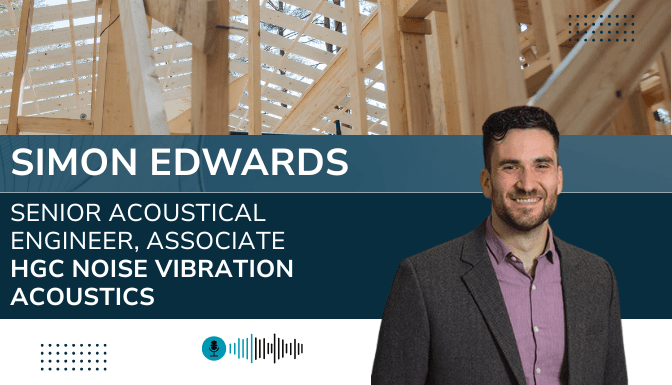
Senior Acoustical Engineer, Associate | HGC Noise Vibration Acoustics
Simon is a member of HGC built environment division, whose acoustical work has spanned the permitting, design, construction, and post-occupancy phases of residential and commercial buildings. He has experience working on buildings with poured concrete, hollow-core, wood-frame, mass timber, and steel-deck structures, including proprietary building structures such as Hambro or iSpan. His work has comprised both base-building and tenant fit-out scopes, and both new construction and complaint-related (existing building) investigations, including acting as an expert witness in litigious disputes. Simon is a leader at HGC in HVAC Noise Control, including the development of internal modelling resources based on continual emerging theoretical and experimental research publications. Further, he is also an expert at conducting sound transmission testing (e.g., ASTC, NIC, AIIC, and ISR), including both theoretical calculations and experimental sound transmission testing (“Kij Testing”) to specifically evaluate sound transmission flanking in accordance with ISO 12354 and ISO 10848. In this respect, Simon is a member of both the ISO and ASTM Technical Committees on Building Acoustics and a contributing member to the development of ongoing ISO and ASTM standards that govern industry-wide measurement and calculation methodologies around the world. In addition to his work in HVAC Noise Control and sound transmission calculations and testing, Simon has completed a wide variety of projects including noise and vibration feasibility studies, stationary noise studies, speech intelligibility (e.g., STIPA and AI measurements), reverberation control, and wind-induced balcony railing noise. In addition to his role as a project engineer, Simon has also helped develop the HGC Mentorship program and has played a key role in continuing to develop the strategic initiatives of HGC. Simon is fluent in both English and French and has worked in both languages on projects across North America and Europe. Some notable projects Simon has worked on include YW Block Line Supportive Housing Complex, Pier 27 Master-planned Community, Pinewood Film & TV Studios, and Markham Uptown Community.
