
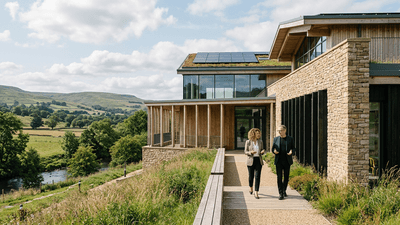



The architectural spotlight in 2026 has temporarily shifted from the soaring skylines of the capital to the historic, culturally rich landscapes of the North. The recent announcement of the 2026 RIBA Yorkshire Awards has crowned five exceptional projects, setting a distinct tone for what constitutes architectural excellence in the current climate. Leading the charge is the York Minster Centre of Excellence—a project that perfectly encapsulates the triad of values celebrated by the jury: unparalleled craft, resolute ambition, and uncompromising environmental responsibility.
For UK architecture professionals, regional awards often serve as the truest barometer of the industry's health and direction. While international mega-projects grab headlines, it is in the regional crucibles like Yorkshire where the daily frictions of budget constraints, stringent heritage planning, and net-zero targets are resolved. The 2026 winners demonstrate that the most compelling architecture emerging today is not necessarily the loudest, but the most deeply rooted in its context.
The New Northern Benchmark: The York Minster Centre of Excellence
To understand the current trajectory of UK regional architecture, one must look closely at the York Minster Centre of Excellence. Designing within the shadow—both literal and figurative—of one of Northern Europe’s most significant Gothic cathedrals is a uniquely daunting brief. The project succeeds not by mimicking the past, nor by brazenly contrasting with it, but by engaging in a rigorous dialogue of materiality and craft.
The Centre of Excellence serves as a vital hub for preserving traditional heritage skills, yet the architecture housing it is decidedly forward-looking. This duality is a masterclass for practitioners navigating Grade I listed environments. It proves that heritage settings are not an excuse for environmental compromise; rather, they are the ultimate testing ground for sustainable innovation.
"The 2026 Yorkshire winners remind us that architectural ambition is no longer measured by scale or formal gymnastics, but by the depth of a project's commitment to its environmental footprint and its local supply chain."
Redefining "Ambition" in 2026
Historically, "ambition" in architectural awards often correlated with structural audacity or vast civic scale. The five projects recognized in Yorkshire this year suggest a profound redefinition of the term. Ambition is now fundamentally linked to environmental metrics and social utility.
- Material Provenance: The winners showcased a forensic approach to material sourcing, prioritizing hyper-local stone, timber, and recycled aggregates. This reduces embodied carbon while directly supporting regional economies.
- Operational Efficiency in Heritage: Achieving low operational energy in historic contexts requires an ambition of detailing. The Yorkshire winners utilized advanced breathable insulations and discreet renewable integrations that respect historic fabric.
- Upskilling the Supply Chain: Projects like the Centre of Excellence demand a level of craftsmanship that forces local contractors to elevate their skills, leaving a lasting legacy of capability in the regional workforce.
Translating Regional Wins into National Practice
What can a practice in Bristol, London, or Glasgow learn from the 2026 Yorkshire cohort? The primary takeaway is the absolute necessity of integrating craft and environmental performance from RIBA Stage 1. The "bolt-on" approach to sustainability is dead; the Yorkshire winners demonstrate that environmental strategies must be the very genesis of the architectural form.
Furthermore, these projects highlight a shift in how architects must communicate with planning authorities. When proposing contemporary interventions in sensitive contexts, the narrative must be grounded in performance and preservation. The architecture must clearly articulate how it secures the future of the historic asset, both structurally and ecologically.
Comparing Approaches: The Evolution of Regional Excellence
To fully grasp the paradigm shift represented by this year's winners, it is useful to compare the traditional approach to regional heritage projects with the new standard established by the 2026 Yorkshire cohort.
| Criteria | Traditional Heritage Approach (Pre-2020) | The 2026 Yorkshire Standard |
|---|---|---|
| Materiality | Focus on visual matching; sourcing often international to reduce costs. | Hyper-local sourcing; focus on embodied carbon and regional supply chain support. |
| Sustainability | Often compromised due to listed status; reliance on offset strategies. | Fabric-first; deep retrofits; discreet integration of renewables as a baseline. |
| Craft | Standardized detailing hidden behind traditional facades. | Bespoke, highly detailed junctions; craft celebrated as a visible architectural feature. |
| Community | Static preservation; looking at history behind glass. | Active engagement; buildings function as working hubs for skills and community (e.g., Centre of Excellence). |
The Future of the UK Architectural Identity
The 2026 RIBA Yorkshire Awards are not an isolated phenomenon. They represent a crystallization of values that have been percolating through UK architecture over the last half-decade. As we face tightening environmental regulations and a challenging economic landscape, the principles of high craft, deep contextuality, and uncompromising carbon awareness offer a resilient path forward.
The success of the York Minster Centre of Excellence and its fellow winners should embolden architects across the UK. It proves that clients and juries alike are ready to reward projects that do the hard, quiet work of sustainable integration. As we look toward the national RIBA Stirling Prize later this year, it is highly likely that the values championed in Yorkshire will set the tone for the entire country. The future of UK architecture is local, crafted, and fiercely responsible—and the North is showing us how it's done.