
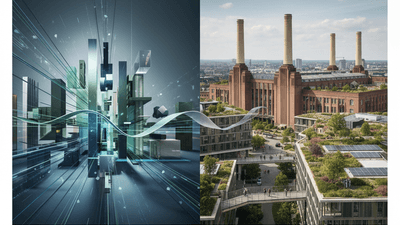



In the ecosystem of British architecture, there exists a vital, oscillating tension between the speculative avant-garde and the pragmatic realities of urban regeneration. This week, that tension is palpable across London and the North West. At the Zaha Hadid Architecture Gallery, the Architectural Association is peeling back the curtain on nearly three decades of digital experimentation, while just a few miles south, the Battersea Power Station masterplan enters a critical new evolutionary phase. These developments, alongside the newly announced RIBA North West shortlist, paint a portrait of an industry in a state of flux—constantly refining the definition of what it means to build for the future.
The Laboratory of the Future: AADRL at Zaha Hadid Gallery
The Architectural Association’s Design Research Laboratory (AADRL) has long been regarded as the engine room of parametricism and algorithmic design in the UK. The new exhibition, 'AADRL: A Work in Progress', currently on view at the Zaha Hadid Architecture Gallery, offers a rare, retrospective look at this pedagogical powerhouse.
Since its inception in 1996, the DRL has operated less like a traditional master’s programme and more like a tech startup incubator. The exhibition showcases a lineage of architectural research that prioritises process over static form. By situating this work within the gallery dedicated to Zaha Hadid—an AA alumna whose own career trajectory defined the transition from paper architecture to built reality—the curation underscores a critical narrative: today's radical experiment is tomorrow's structural norm.
Defining the 'Work in Progress'
The title of the exhibition is instructive. In the context of the AADRL, a "work in progress" is not an unfinished building, but a methodology. The displays highlight how the programme has pioneered the use of coding, robotic fabrication, and agent-based systems to solve complex urban problems. For the practising architect, the value here lies in observing the genealogy of tools we now take for granted.
"The exhibition showcases architectural research, experimentation, and collaboration since 1996, highlighting the programme's commitment to challenging the status quo of the built environment."
Visitors can expect to see how early experiments in scripting have evolved into sophisticated responsive environments. The show emphasises collaboration—a hallmark of the DRL studio culture—reminding the profession that the complexity of modern architecture has rendered the myth of the 'lone genius' obsolete.
For firm directors and lead architects, the AADRL exhibition serves as a reminder to invest in R&D. The computational workflows exhibited—once deemed purely academic—are now essential for carbon analysis, material optimisation, and complex geometry rationalisation in commercial projects.
The Reality of Regeneration: Studio Egret West at Battersea
While the AA explores the digital frontier, the physical reality of London’s skyline continues to shift. In a significant development for one of the capital's most high-profile sites, Studio Egret West has been appointed to masterplan the future phases of the Battersea Power Station regeneration.
This appointment marks a pivotal moment for the remaining 16 acres of the site. The regeneration of Battersea has been a decades-long saga of changing hands and shifting visions. Studio Egret West’s role is to evolve the masterplan for the final stages, ensuring connectivity with the wider Nine Elms opportunity area.
Bridging the Urban Gap
The challenge for Studio Egret West is distinct from the academic tabula rasa of the DRL. They must weave together existing disparate elements, including the imposing industrial heritage of the Power Station and the forthcoming architectural statements by Frank Gehry and Foster + Partners. The focus is now on the "connective tissue" of the city—specifically linking the development to Nine Elms Park.
We can observe a clear distinction between the academic approach to urbanism and the commercial reality currently playing out in Battersea:
| Feature | Academic Urbanism (e.g., AADRL) | Commercial Masterplanning (e.g., Battersea) |
|---|---|---|
| Primary Driver | Algorithmic logic / Social theory | Viability / Placemaking / Connectivity |
| Flexibility | High (Digital iteration) | Constrained (Planning / Land ownership) |
| Timeline | Speculative futures (2050+) | Phased delivery (Immediate to 10 years) |
| Outcome | Provocation / Prototype | Public Realm / Mixed-Use Density |
The firm's mandate includes integrating new buildings designed by Gehry Partners, suggesting that the "starchitect" era is far from over, but is being tempered by a stronger emphasis on landscape-led masterplanning—a speciality of Studio Egret West.
Regional Excellence: RIBA North West Shortlist
Moving beyond the M25, the architectural narrative shifts from density and computation to heritage and civic infrastructure. The Royal Institute of British Architects (RIBA) has announced its shortlist for the 2026 North West Awards, highlighting 10 projects that exemplify regional resilience.
This year's shortlist is particularly notable for its diversity of scale and function. It serves as a counterweight to the London-centric discourse, proving that high-calibre design is thriving in the regions. Key projects to watch include:
- Rochdale Town Hall: A monumental restoration project. This Grade I listed gothic revival building has undergone extensive conservation, restoring its status as a civic pride of the North. It represents the "retain and reuse" ethos that is becoming central to the UK's sustainability strategy.
- Isle of Man Ferry Terminal, Liverpool: A crucial piece of transport infrastructure. This project highlights the complex interplay between maritime engineering and civic architecture.
The shortlist reflects a broader trend in UK architecture: a move away from vanity projects toward buildings that serve a distinct civic or social function. Whether it is preserving the gothic grandeur of Rochdale or facilitating transport links in Liverpool, these projects are grounded in the immediate needs of their communities.
Conclusion: The Feedback Loop
There is a thread connecting the digital experiments at the Zaha Hadid Gallery, the evolving masterplan at Battersea, and the civic restorations in the North West. It is the feedback loop between research and reality.
The AADRL provides the raw computational logic that eventually filters down into the tools used by firms like Studio Egret West to manage complex masterplans. Meanwhile, the constraints faced by projects on the RIBA shortlist—budget, heritage, and public utility—provide the necessary friction that prevents architectural theory from becoming irrelevant.
For the UK professional, the message is clear: innovation is not just about the new code written in a university lab, nor is it solely about the concrete poured in Nine Elms. It is about the agility to move between these worlds—applying the rigour of research to the messiness of the building site.