
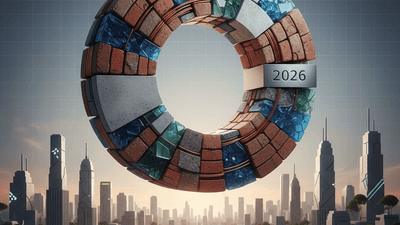



In the heart of the UK's industrial heartlands, the kilns are roaring without pause. Housebuilder Persimmon recently announced that its in-house brickworks is now operating on a punishing 24/7 schedule, a stark, fiery testament to the relentless pressure of the nation's housing crisis. Yet, simultaneously, the architectural establishment is celebrating a very different approach to materiality—one that champions the painstaking, quiet work of dismantling, salvaging, and reusing. For UK architecture professionals in 2026, this presents a profound paradox: how do we reconcile the commercial necessity for unprecedented volume with the ecological imperative of circular design?
As we navigate this complex landscape, the contrast between mass production and material repurposing has never been sharper. The decisions we make at the specification stage today will define the resilience, aesthetic, and carbon footprint of the UK's built environment for decades to come.
The Drive for Volume: Vertical Integration as Survival
The news that Persimmon's brick factory is working 24/7 to meet demand highlights a critical shift in how major developers are insulating themselves against supply chain volatility. By boosting production across its in-house brick, tile, and timber frame factories, and with plans to expand capacity further throughout 2026, Persimmon is doubling down on vertical integration.
For architectural practices working alongside or within large-scale residential development, this trend has significant practical implications. When a developer controls its own material supply, the architectural vocabulary is often pre-dictated by the factory's output.
- Standardization over Customization: Architects must find creative ways to generate distinct placemaking and varied streetscapes using a highly standardized kit of parts.
- Supply Chain Certainty: Specifying in-house materials guarantees delivery timelines, a crucial factor when managing risk in fixed-price contracts.
- The Carbon Cost: While timber frame production offers sequestration benefits, 24/7 brick firing is inherently carbon-intensive, placing pressure on architects to find carbon offsets elsewhere in the design (such as operational energy efficiency).
"The shift toward 24/7 in-house manufacturing by volume housebuilders is less about architectural preference and entirely about de-risking the delivery of housing targets. The challenge for the architect is to inject humanity and localized context into a hyper-industrialized process."
The Counter-Movement: Championing the Circular Economy
While the kilns burn continuously to forge new materials, the vanguard of architectural thought is pulling in the opposite direction. This year, Swiss architect Barbara Buser was recognized with the 2026 Jane Drew Prize for her pioneering work in circular construction. Awarded as part of the W Awards by The AJ and The Architectural Review, the prize spotlights Buser's decades-long commitment to repurposing practices.
Buser's philosophy fundamentally rejects the "take-make-dispose" model that necessitates 24/7 brick production. Instead, her work views the existing built environment as an urban mine. For UK practitioners, Buser's recognition is not just a nod to a niche sustainability practice; it is a clear signal that the metrics for architectural excellence are shifting.
Practical Steps Toward Circularity in the UK
Integrating Buser's principles into a UK market dominated by tight margins and fast-track schedules requires strategic foresight:
- Pre-Demolition Audits: Before clearing a site, conduct rigorous audits to identify materials (steel sections, brickwork, timber) that can be harvested and recertified for the new build.
- Designing for Deconstruction (DfD): Move away from wet trades and chemical adhesives where possible. Opt for mechanical fixings that allow future generations to dismantle and reuse components without destroying them.
- Material Passports: Implement digital material passports in your BIM models, creating a traceable inventory of what has been installed, facilitating easier reuse at the end of the building's lifecycle.
Global Benchmarks for Local Practice
This tension between volume and ecological responsibility is a global challenge, as evidenced by the recently announced RIBA International Awards 2026 shortlist. Featuring 52 projects spanning 18 countries, the shortlist is a masterclass in how architects are addressing complex social, cultural, and environmental challenges.
What stands out in the 2026 RIBA selection is the synthesis of scale and sensitivity. The shortlisted projects do not shy away from the need to house, educate, and heal large populations, but they do so by leveraging local material supply chains, vernacular passive cooling techniques, and adaptive reuse. For UK architects, these international examples prove that high-capacity infrastructure does not have to rely solely on high-carbon, mass-produced materials.
The Architect's Dilemma: Specifying in 2026
How, then, does the modern UK architect bridge the gap between Persimmon's 24/7 brickworks and Barbara Buser's circular utopia? It requires a hybrid approach to specification, understanding when to deploy mass-produced efficiency and when to insist on circular interventions.
| Material Strategy | Primary Benefit | Key Challenge | Best Application in UK Context |
|---|---|---|---|
| Vertically Integrated Mass Production (e.g., In-house Bricks) | Unmatched speed, cost predictability, and volume capacity. | High embodied carbon; risk of homogenous, "copy-paste" aesthetics. | High-volume affordable housing; structural envelopes requiring rapid weather-tightness. |
| Circular & Salvaged Materials | Drastically reduced embodied carbon; unique aesthetic character. | Supply inconsistency; complex recertification and warranty processes. | Feature facades, public realm interventions, interior fit-outs, and boutique commercial projects. |
| Bio-based & Timber Frame | Carbon sequestration; excellent thermal performance. | Moisture management during construction; evolving fire safety regulations. | Low-to-mid rise residential; educational facilities; hybrid structures. |
The reality of UK construction means that we cannot entirely abandon mass production tomorrow. The housing deficit is too severe. However, we can aggressively optimize how we use these materials. If a project relies on 24/7 mass-produced bricks for its primary envelope, the architect must ensure the building is designed to last a century, and that its interior components are entirely modular and circular.
Looking Forward: A Synthesis of Forces
As we progress through 2026, the UK architecture sector is standing at a crossroads. The roar of the 24/7 brick factory is a sound of commercial success and societal necessity, but it is also an echo of an industrial era we must eventually transition away from. The recognition of architects like Barbara Buser and the diverse, environmentally conscious projects celebrated by the RIBA International Awards illuminate the path forward.
The most successful UK practices over the next decade will be those that refuse to see volume and values as mutually exclusive. By demanding better environmental product declarations (EPDs) from mass manufacturers, advocating for the recertification of salvaged materials, and designing buildings that serve as material banks for the future, architects can forge a built environment that honors both the urgency of today and the ecological necessities of tomorrow.