
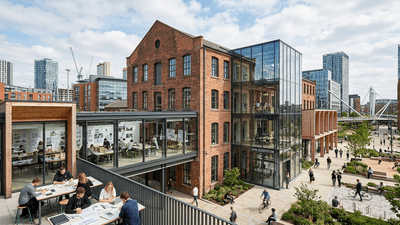



The United Kingdom’s high streets and regional town centres are undergoing a profound metamorphosis. For decades, the architectural spotlight has been disproportionately trained on glossy metropolitan megaprojects. However, in 2026, the profession’s centre of gravity is shifting decisively toward localism, civic renewal, and adaptive reuse. This is not merely a change in the types of projects being commissioned; it represents a fundamental realignment of the architectural ecosystem—from how students are taught and professionals are registered, to where practices choose to anchor their studios.
Recent developments across the sector illustrate a profession that is decentralising its footprint, modernising its regulatory frameworks, and grounding its educational models in real-world community needs. For practice leaders navigating this landscape, understanding the connective tissue between these shifts is essential for future-proofing their firms.
The Civic Catalyst: Breathing New Life into Local Heritage
The clearest indicator of this civic shift is the type of work currently winning public sector backing. A prime example is the recent announcement that Ashford Borough Council has appointed Stirling Prize-winning practice Haworth Tompkins to transform a former 1930s Odeon cinema into a dynamic new cultural and community venue.
Haworth Tompkins, renowned for their masterful handling of theatrical and cultural spaces (such as the Everyman Theatre and the National Theatre), brings a level of design pedigree to Ashford that signals a high-water mark for regional civic ambition. The Odeon project is emblematic of a wider national strategy to pivot high streets away from purely retail-driven models toward experiential, cultural, and community-focused anchors.
"The adaptive reuse of our 20th-century civic heritage is no longer a niche conservation exercise; it is the primary engine for high street regeneration. By inserting modern cultural infrastructure into familiar historic shells, architects are performing vital civic repair."
For UK architects, the Ashford Odeon project underscores several vital practice takeaways:
- Embodied Carbon as a Baseline: Retaining the 1930s structure aligns with stringent carbon targets, proving that adaptive reuse is both a cultural and environmental imperative.
- Public-Sector Partnerships: Local authorities are increasingly acting as the primary catalysts for high-quality architectural interventions in regional towns.
- Multi-use Programming: The brief demands flexibility—spaces that can seamlessly transition from daytime community hubs to evening performance venues.
Regional Rebalancing: The Pull of the North
As the demand for regional civic and commercial projects grows, architectural practices are physically realigning to meet it. The traditional model of a London-centric headquarters parachuting into regional towns is rapidly losing its appeal to clients who demand deep, embedded local knowledge.
This trend is exemplified by architecture and interior design practice CPMG's recent expansion into Leeds. Opening a new regional studio in Yorkshire, CPMG is positioning itself to capture growing demand across the North of England. This strategic move highlights a broader industry recognition that the Northern Powerhouse and regional levelling-up agendas require on-the-ground architectural expertise.
Expanding into regional hubs like Leeds offers practices several distinct advantages:
- Proximity to Decision Makers: Being embedded in the local business and political ecosystem fosters stronger relationships with regional developers and local authorities.
- Talent Acquisition: Regional studios tap into rich local talent pools, often graduates from highly respected Northern universities who prefer to build careers outside the capital.
- Contextual Sensitivity: A physical presence ensures that design responses are rooted in a genuine understanding of local vernacular, economic drivers, and community dynamics.
Bridging the Gap: Real-World Pedagogy
To sustain this regional and civic-focused pipeline, the education of the next generation of architects must evolve. The historic disconnect between the theoretical isolation of the design studio and the pragmatic realities of practice has long been a source of friction for employers.
Fortunately, academia is responding. The University of Staffordshire recently won a national award from the Standing Conference of Schools of Architecture (SCOSA) for its innovative 'vertical live studio' teaching model. This pedagogical shift is exactly what the profession requires right now.
The 'vertical live studio' model dismantles traditional academic silos by mixing students from different year groups and tasking them with real-world, client-facing briefs—often situated within their immediate local communities. This approach achieves three critical outcomes for the profession:
- Client Communication: Students learn to articulate design value to non-architects, a crucial skill for community consultation in projects like the Ashford Odeon.
- Collaborative Hierarchy: Mixing year groups simulates the hierarchy and collaborative environment of a real architectural practice.
- Civic Responsibility: By working on live local briefs, students develop an early understanding of architecture's social impact and civic duty.
Structural Modernisation: The ARB’s New Assurance Process
If pedagogy is the foundation and regional practice is the vehicle, regulation is the road upon which the profession travels. To support a dynamic, modern profession, the regulatory framework must be both rigorous and accessible.
In a significant structural update, the Architects Registration Board (ARB) has approved a new Registration Assurance Process. This initiative is designed to modernise how architects join and return to the UK Register, strengthening routes to registration while ensuring robust competency standards.
The new process is a vital piece of the puzzle for a profession that needs agility to staff regional expansions and tackle complex adaptive reuse projects. By streamlining the return-to-practice routes, the ARB is helping to retain experienced professionals who may have taken career breaks (often disproportionately affecting women in the industry). Furthermore, a clearer, modernised initial registration process ensures that the steady stream of practically trained graduates—like those from Staffordshire—can transition smoothly into registered professionals.
The Evolution of the UK Architectural Ecosystem
To understand the trajectory of the profession, we can map the shift from the traditional model to the emerging 2026 civic model:
| Domain | Traditional Model | 2026 Civic Model |
|---|---|---|
| Practice Location | Highly centralised (London/South East bias) | Decentralised, embedded regional studios (e.g., Leeds) |
| Project Focus | New build, commercial, retail-driven | Adaptive reuse, cultural/civic anchors (e.g., Odeon) |
| Education | Theoretical, isolated year groups, hypothetical briefs | Vertical live studios, real-world community briefs |
| Regulation | Rigid, linear pathways to registration | Modernised Assurance Process, flexible return routes |
Conclusion: Designing the Future from the Ground Up
The transformation of a 1930s cinema in Ashford by Haworth Tompkins is not an isolated architectural event; it is the physical manifestation of a broader, systemic evolution within UK architecture. As firms like CPMG expand their regional footprints to meet local demand, they are increasingly relying on a pipeline of talent that has been trained in the real-world complexities of the 'vertical live studio'. Simultaneously, the ARB’s modernised Registration Assurance Process ensures that the regulatory framework supports, rather than hinders, the flow of this vital talent.
For UK architecture professionals, the message is clear: the future of the profession is intrinsically linked to local civic renewal. Success in the latter half of this decade will belong to those practices that embed themselves within regional communities, champion adaptive reuse, hire practically minded graduates, and actively participate in the modernised structural ecosystem of the profession. By aligning education, regulation, and regional practice, UK architecture is well-positioned to rebuild our civic spaces from the ground up.