Master the design, analysis, and construction of deep foundations and excavations. Gain practical insights into soil mechanics, bearing capacity, and earth retention for robust, cost-effecti
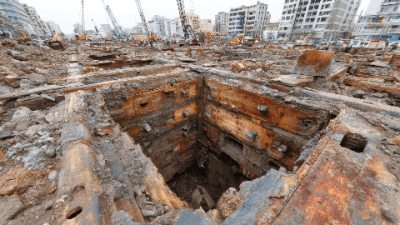
Unlock the complexities of designing and constructing robust foundations with this comprehensive course, "Deep Foundations and Excavations." Delve into essential soil mechanics principles, bearing capacity analysis, and earth retention techniques critical for modern infrastructure projects. This program equips engineers with the knowledge to select, analyze, and inspect deep foundation systems effectively.
Key learning outcomes include:
This course integrates both theoretical concepts and practical, experience-driven insights, ensuring a thorough understanding of deep foundations and excavations from design to field implementation and quality assurance.

Online Courses for Engineers
HalfMoon Education is a nonprofit continuing education provider offering live webinars and on-demand courses for engineers, architects, landscape architects, land surveyors, attorneys, paralegals, accountants and others. Since 1996, we’ve helped thousands of professionals nationwide stay current with industry standards and codes, earn CE hours, and advance their expertise through practical, expert-led learning experiences. Learn more about us at: www.halfmoonseminars.org
Director, Group Lead, Massachusetts Consulting, Geocomp | Ph.D. P.E.
Dr. Vytiniotis is a member of the Geo‐Institute’s Deep Foundation and Computation Geotechnics committees and a regional Director for the Society of Construction Law – North America. He has background in structural and geotechnical engineering, geotechnical earthquake engineering, and numerical analysis. Dr. Vytiniotis has worked on numerous projects in more than 20 states and multiple countries, assisting project owners, law firms, insurance companies and developers. His analyses consist of assessing soil improvement, soil‐structure interaction, dam safety, causation of MSE wall failures, effects of adjacent construction (such as vibrations or pile driving), soil heave or settlements, pipeline installation, water intrusion, and backfill quality. Dr. Vytiniotis is experienced in evaluating slope stability, performing mechanical and flow‐through‐porous media finite element analyses and soil‐structure interaction using various software such as Plaxis, Flac, Geostudio, ABAQUS, LPILE, FEFLOW and GROUP. Additionally, he has experience in data analysis, signal processing and GIS. Dr. Vytiniotis has performed research on the seismic response of pile‐supported wharves, seismic slope stability, the effectiveness of prefabricated vertical drains (earthquake drains) and soil densification in reducing liquefaction risk, the effect of gravel drains in amplifying seismic accelerations, and numerical simulations of centrifuge experiments. In the past, he gained international experience in Greece and Switzerland and was appointed lecturer at MIT.
Project Manager at Geocomp | Ph.D., P.E.
Dr. Mousavi specializes in geotechnical engineering, earthquake engineering, transportation geotechnics, unsaturated soil mechanics, and in‐situ and advanced laboratory soil testing. With a professional career spanning over 10 years, he has successfully contributed to a wide range of projects across multiple states, as well as in Eastern Europe, the Middle East, and Southeast Asia. He is well versed in applied research and design and evaluation of geotechnical systems as well as assessment and mitigation of construction defects, geotechnical failures, and natural hazards. Dr. Mousavi’s extensive experience extends to the design and evaluation of ground improvement systems, deep and shallow foundations, drilled shafts and driven piles, slopes, retaining walls, storage tanks, flexible and rigid pavements, geometric design of roadways, static and seismic‐induced liquefaction, liquefaction mitigation techniques, wind farms, earthquake‐induced settlement, site‐specific response analysis, laterally loaded piles, soil heave and settlement and mitigation techniques, soft clay and peat, dewatering systems, earth‐fill dams, differing site conditions, and defective specifications.
Executive Vice President of GRL Engineers, Inc. and Executive Director of Global Industry Relations at Pile Dynamics, Inc., the world’s oldest and largest specialty deep foundations testing
In Mr. Hussein’s 40+ years career he has consulted on more than 1,000 deep foundations projects in 35 States in the USA and several countries. He frequently organizes educational courses and seminars on deep foundations, including the American Society of Civil Engineers’ (ASCE) Continuing Education Class: Deep Foundations Design, Construction, and Quality Control. In Mr. Hussein is a member of the deep foundations related committees of DFI, ASTM, PDCA, ASCE, and TRB. He has Chaired the Deep Foundations Committee of the ASCE’s Geo‐Institute (2002‐2009), and the PDCA’s Education Committee (2012‐2013); and currently Chairs the PDCA’s Technical Committee. In Mr. Hussein is the recipient of several professional and industry awards and recognitions. He has published over 60 technical papers, and co‐edited 10 engineering books. In Mr. Hussein has achieved expert level on the PDCA/PDI Dynamic Measurement and Analysis Proficiency Test and on the Foundation QA High Strain Dynamic Pile Testing examination and is a registered professional engineer in several States. Mr. Hussein conceived and Chaired the first International Foundations Congress and Equipment Expo (IFCEE‐2009) that has been periodically repeated and is now an industry landmark.
