Intended for Water Resources, Civil, Environmental, Transportation, and other engineers whose job description requires a general knowledge of streambank and habitat protection methods.
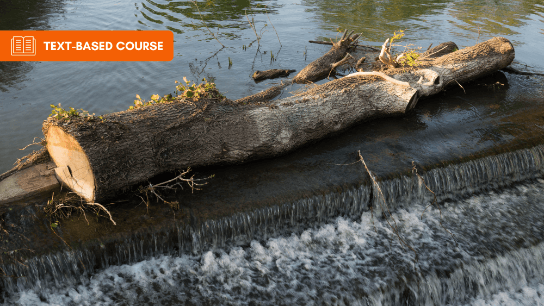
Large woody materials (LWM) have been used for river training and stabilization for centuries. LWM structures are intended to provide habitat and stabilization until woody riparian vegetation and stable bank slopes can be established.
Topics: Introduction to LWM Structures Areas of applicability Environmental and habitat considerations Design Considerations Types and Selection of LWM structures Dimensions for intermittent LWM structures Force and moment analysis Ballast and anchoring Materials, Cost, Maintenance Intended Audience: This course is intended for Water Resources, Civil, Environmental, Transportation, and other engineers whose job description requires a general knowledge of streambank and habitat protection methods.

Dr. Harlan Bengtson is an online PDH course provider of continuing education courses for professional engineers. Dr. Bengtson is a graduate of Iowa State University with B.S. and M.S. degrees and of the University of Colorado with a PhD. He is a licensed Professional Engineer in Missouri. Dr. Bengtson has spent 30 years in engineering education in teaching and administrative positions, including six years as Dean of Engineering at Southern Illinois University Edwardsville. Dr. Harlan H. Bengtson, PE 33 Grainey Drive Glen Carbon, IL 62034 Phone: (618) 406-6892 E-mail: hnkbengtson@yahoo.com PROFESSIONAL PROFILE Dr. Bengtson is a graduate of Iowa State University with B.S. and M.S. degrees and of the University of Colorado with a PhD. He is a licensed Professional Engineer in Missouri. He has spent 30 years in engineering education in teaching and administrative positions, including six years as Dean of Engineering at Southern Illinois University Edwardsville. His areas of expertise are environmental engineering, hydrology and hydraulics, engineering science and renewable energy systems. He has done regular consulting work while holding the academic positions. Prior to entering academia, Dr. Bengtson worked for Minnesota Mining & Manufacturing as a Product Development Engineer and for E. I. duPont deNemours as a Process Development Engineer. Dr. Bengtson has authored numerous publications, presentations and technical reports. He is currently active as a freelance technical writer, author of continuing education courses for Professional Engineers, and is the founder of www.engineeringexceltemplates.com and www.EngineeringExcelSpreadsheets.com, sites with the objective of providing inexpensive, easy to use Excel spreadsheets for a variety of engineering calculations.
